
Casa Batlló, located at Passeig de Gràcia 43 in Barcelona, is an iconic modernist masterpiece designed by Antoni Gaudí between 1904 and 1906. Known as the ‘House of Bones,’ it is a UNESCO World Heritage site recognized for its skeletal stone balconies, vibrant trencadís mosaic façade, and revolutionary biophilic architecture that defies traditional structural rules.
The History Behind the House of Bones
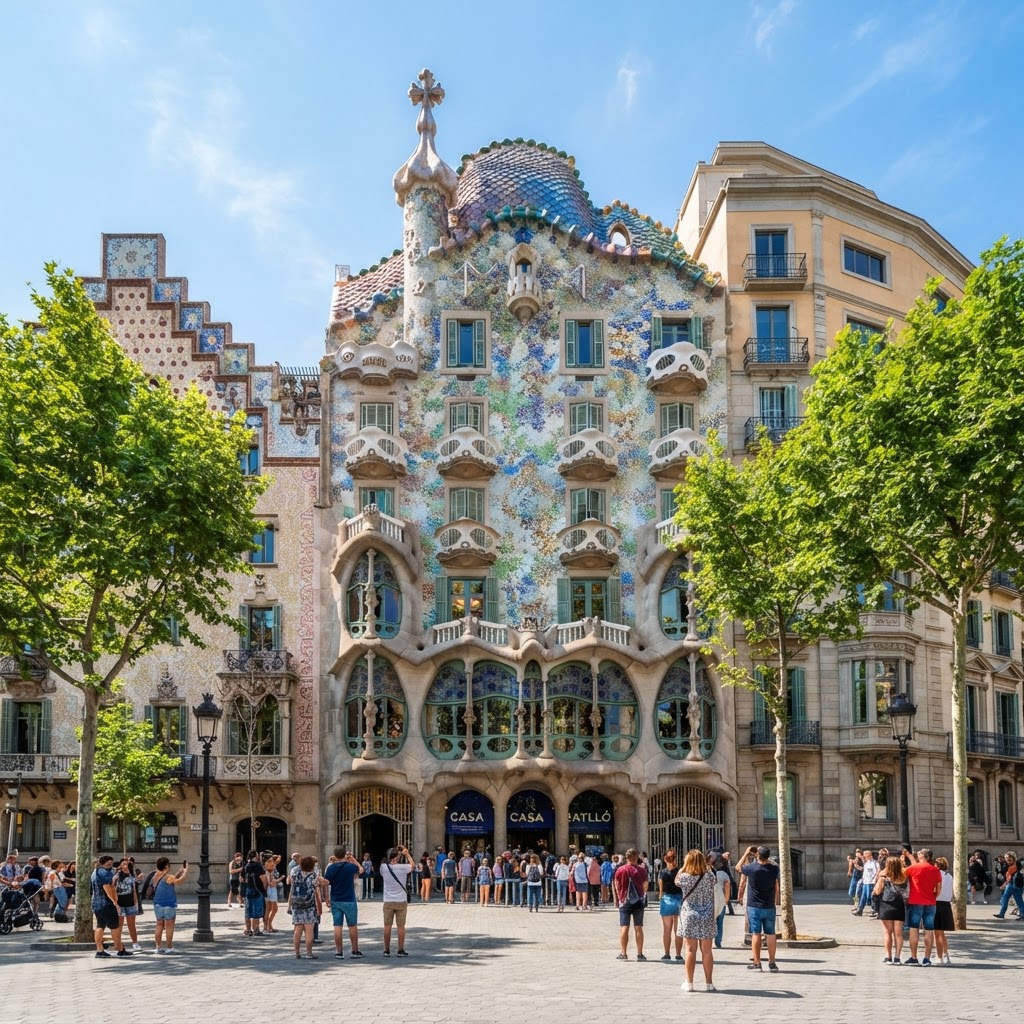
In 1903, the wealthy industrialist Josep Batlló i Casanovas purchased a standard residential building and tasked Antoni Gaudí with its complete redesign, granting him total creative autonomy. Gaudí rejected the initial plan to demolish the building, opting instead to reconstruct the façade, increase the height of the structure, and add a fifth floor. Construction lasted from 1904 to 1906, resulting in a radical departure from the rigid, grid-like architecture of the Eixample district. Gaudí utilized ‘trencadís,’ a mosaic technique repurposing ceramic waste from local factories, to create the building’s signature shimmer. By avoiding straight lines, which he argued were absent in nature, Gaudí transformed a generic house into an organic, living organism. The renovation set a new standard for Modernisme, integrating structural functionality with sculptural art to influence global design trends for the next century.
A Radical Transformation
When Gaudí began the project in 1904, he completely reimagined the façade, the interior, and the roof. He infused the building with his signature style, characterized by curved lines, irregular shapes, and a lack of straight edges. The result was a house that breathed, moved, and shimmered under the Mediterranean sun.
The ‘House of Bones’ Legend
The nickname ‘House of Bones’ (Casa dels Ossos) comes from the building’s skeletal appearance. The balconies look like masks, and the support pillars resemble bone structures. Visitors often wonder if these designs were intentional or mere accidents of style. In truth, Gaudí drew his inspiration directly from nature, avoiding straight lines because he believed they did not exist in the natural world.
Architectural Marvels of the Façade
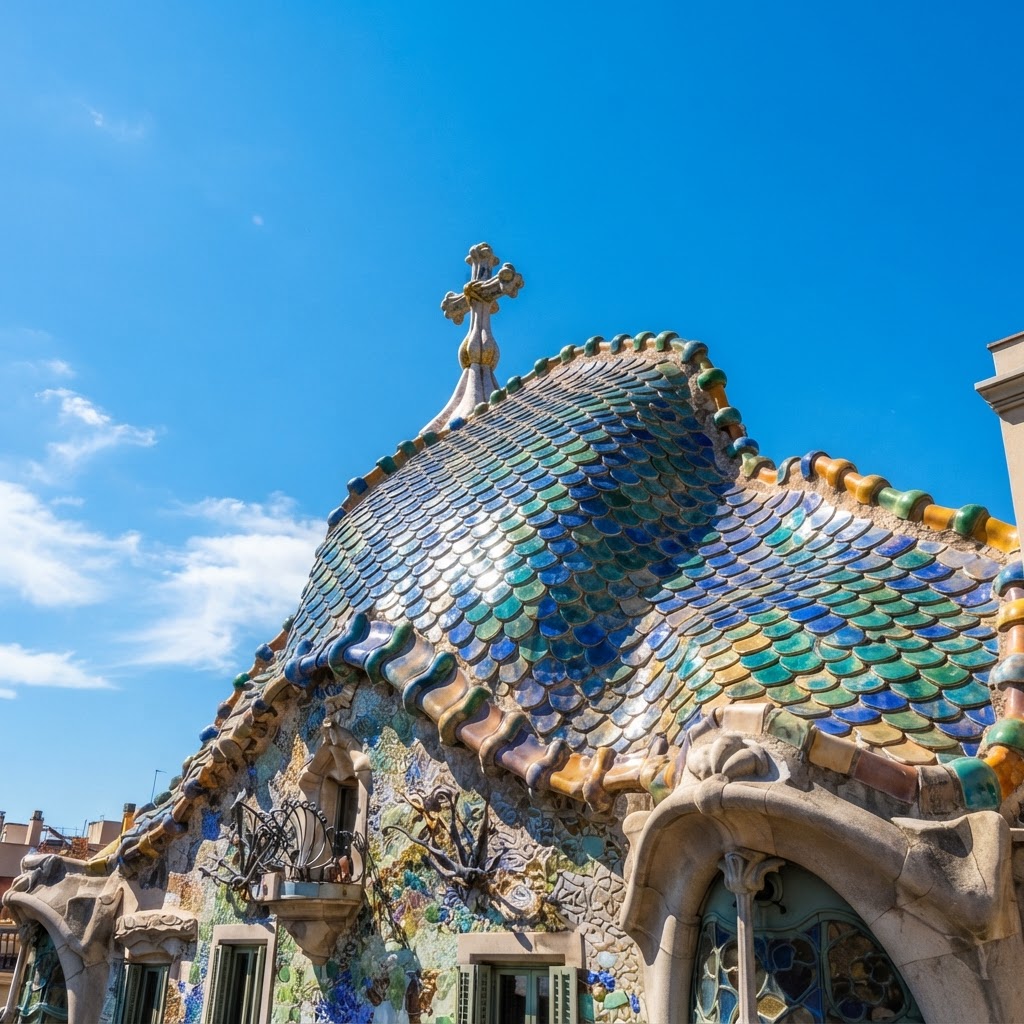
The façade of Casa Batlló is defined by its masterful use of light, texture, and symbolic narrative. Covering the exterior is the trencadís, a mosaic composed of thousands of discarded ceramic shards that reflect sunlight to simulate the movement of water. This technique was not merely aesthetic; it provided a durable, weather-resistant finish that has stood for over 120 years. Architectural scholars widely interpret the façade as a visual retelling of the legend of Saint George and the Dragon. The roof, arched like a beast’s spine and covered in vibrant tiles, represents the dragon’s back. A four-armed cross sits at the apex of the roof, symbolizing the sword of Saint George. The balconies, crafted from cast iron, serve as both decorative elements and structural supports, appearing like masks or skulls depending on the light. These elements work in tandem to create a building that feels alive, shifting in appearance from dawn to dusk as the sun travels across the Passeig de Gràcia.
Symbolism in the Stonework
Many historians suggest that the façade represents the legend of Saint George, the patron saint of Catalonia. The roof, which is arched like the back of a dragon, features tiles that represent scales. A single tower with a four-armed cross sits at the top, symbolizing the sword of the saint piercing the dragon’s back.
The Balconies and Light
The balconies are made of cast iron and have a skeletal design that contrasts sharply with the colorful glass and ceramic tiles covering the exterior. The windows are designed to maximize natural light, creating a bright and airy atmosphere that flows seamlessly from the street into the interior living spaces.
Exploring the Interior Design
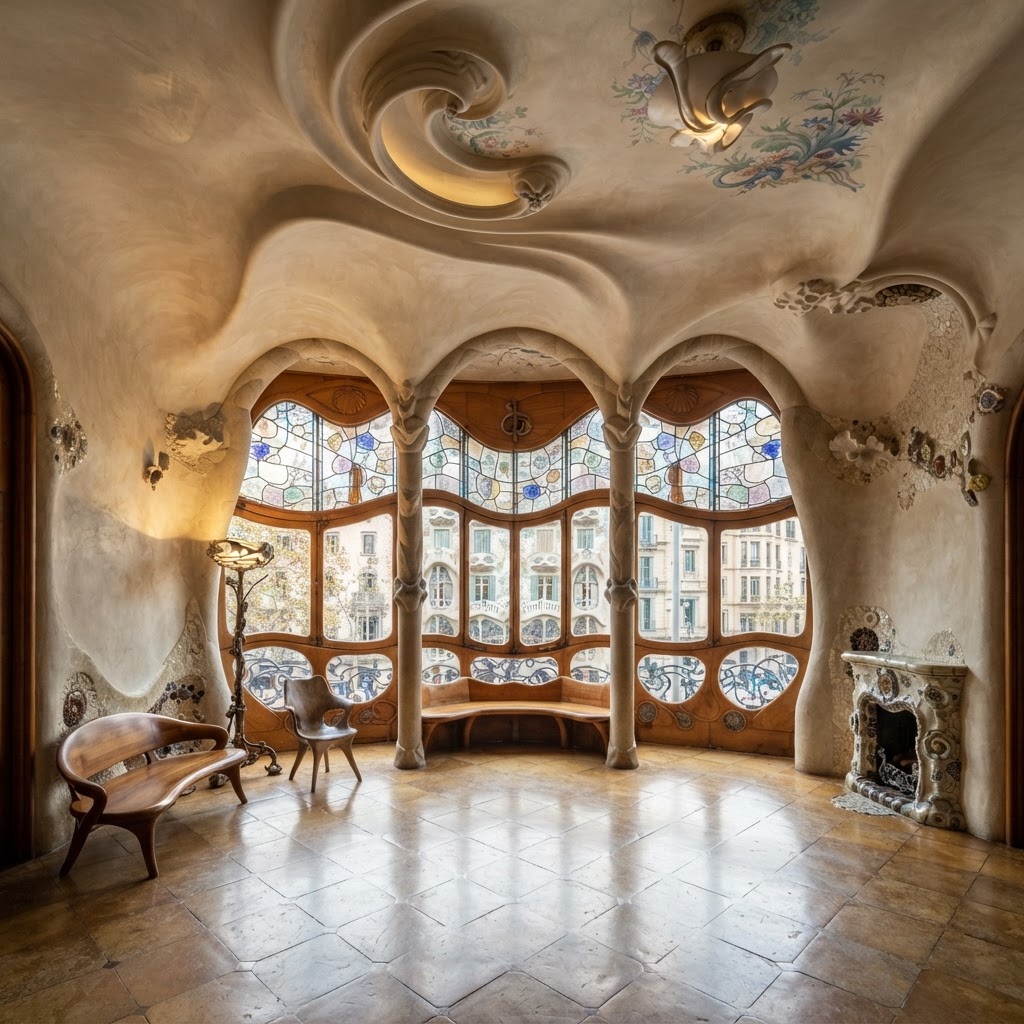
Inside Casa Batlló, Gaudí achieved a ‘total work of art’ where every functional object, from handles to vents, reflects the interior’s aquatic theme. He designed the Noble Floor (Piano Nobile) to serve as the Batlló family’s primary residence, featuring sweeping, organic curves and ceilings that mimic the whorls of a seashell. A masterpiece of engineering, the central light well uses varying intensities of blue tiles to distribute natural light evenly across all floors, becoming darker at the top and lighter at the bottom to counteract shadows. This design ensures that residents experience consistent brightness throughout the day. Every detail, including the oak-wood doors and hand-carved fireplaces, prioritizes ergonomics while maintaining the fluid, sea-inspired aesthetic. Visitors navigating the interior encounter staircases that mimic a dragon’s spine and ventilation systems disguised as elegant woodwork, showcasing Gaudí’s refusal to sacrifice comfort for artistic expression.
The Noble Floor
The Noble Floor (Piano Nobile) was the residence of the Batlló family. It features large, fluid windows that overlook the main street, providing an incredible vantage point. The ceilings are sculpted with swirling, organic motifs that draw the eye toward the center of the rooms, creating a sense of movement and depth.
The Light Well
One of the most impressive feats of engineering in the building is the central light well. Gaudí designed this space to ensure that natural light and fresh air reached even the innermost corners of the house. He used varying shades of blue ceramic tiles, graduating from darker at the top to lighter at the bottom, to ensure uniform light distribution.
The Dragon’s Back and Rooftop
The rooftop terrace of Casa Batlló serves as both an artistic statement and a functional utility space, highlighting Gaudí’s foresight in sustainable design. The ‘dragon’s back’ is constructed from ceramic tiles arranged in varying colors and patterns, functioning as a drainage system that keeps the structure protected from heavy rainfall. This elevated viewpoint offers a panoramic perspective of the Eixample district’s unique grid layout, providing a stark contrast to the fluid, non-Euclidean curves of the terrace itself. Unlike the flat rooftops found on nearby buildings, Gaudí’s design incorporates stylized chimneys that are sculpted to channel smoke away from the house effectively. It remains one of the most photographed spaces in Barcelona, blending utility with mystical architecture. For visitors, the rooftop represents a moment of serenity in the heart of a bustling city, allowing for a deep appreciation of the structural geometry that defines Casa Batlló’s silhouette against the Mediterranean horizon.
Views of Barcelona
Standing on the terrace, you get a 360-degree view of the city’s grid system, which serves as a striking contrast to the organic curves of the rooftop itself. It is a place for reflection and wonder, offering a perspective on Barcelona that few other landmarks can provide.
Visitor Tips and Insights
Planning a visit to Casa Batlló requires strategic timing to ensure the best experience and avoid the high density of tourists that typically visit between 11:00 AM and 4:00 PM. Tickets are strictly limited and sell out frequently, so booking at least 14 days in advance is essential for your preferred time slot. We recommend selecting the ‘early bird’ entry to enjoy the Noble Floor before the crowds, or the late evening slot to see the house illuminated against the night sky. The visit generally lasts 90 to 120 minutes, including an immersive AI-powered audio guide that provides deep context into Gaudí’s life and specific architectural choices. Be aware that while the building is partially accessible, the historical nature of the spiral staircases limits access to some of the smaller architectural nooks.
What to Know Before You Go
Conservation and Global Recognition
Maintaining the structural integrity of Casa Batlló is a permanent, multi-million dollar effort that adheres to strict UNESCO World Heritage guidelines. Conservation teams work year-round to stabilize the original trencadís tiles, which are prone to thermal expansion, and to restore the internal wooden finishings that have aged since the 1906 completion. The site is a global benchmark for biophilic design, which posits that buildings should mimic natural systems to promote psychological well-being. By integrating organic light, ventilation, and non-linear shapes, Gaudí’s vision remains a pillar of modern sustainability research. The ongoing restoration efforts are documented and audited, ensuring that every replacement piece is sourced from materials matching the original composition. This dedication ensures that Casa Batlló remains as vivid and structurally sound as it was during the height of the Catalan Modernisme movement.
Why It Remains Relevant
Despite being over a century old, the house continues to inspire architects and designers globally. Its focus on biophilic design—bringing the patterns and forms of nature into the built environment—is a trend that is only becoming more important in modern sustainability and urban planning. Gaudí was truly ahead of his time.
FAQ
How much does it cost to enter Casa Batlló?
Standard adult entry tickets typically start at approximately 35 euros, though prices vary based on the experience type, such as ‘Blue,’ ‘Silver,’ or ‘Gold’ tiers. It is highly recommended to book online in advance to avoid potential price hikes or total unavailability at the door.
Do I need to book tickets in advance?
Yes, booking tickets in advance is mandatory. Casa Batlló frequently sells out weeks ahead of time, particularly during the peak spring and summer tourist seasons in Barcelona, so online reservation is the only way to guarantee entry.
How long does a typical visit take?
Most visitors spend between 1.5 to 2 hours exploring the house. This timeframe allows sufficient time to listen to the provided AI audio guide, view all floors, and spend time on the rooftop terrace without feeling rushed.
Is Casa Batlló accessible for people with disabilities?
Yes, Casa Batlló is partially accessible. The building is equipped with elevators that provide access to the majority of the rooms, though certain areas with narrow passages or steps may be difficult to navigate for individuals with limited mobility.
Why is Casa Batlló called the ‘House of Bones’?
It is nicknamed the ‘House of Bones’ because of its unique external structure. The stone columns on the lower floors resemble skeletal bones, while the balconies are shaped like skull-like masks, which created a striking and somewhat eerie impression on the local citizens when it was first completed.
Leave a Reply