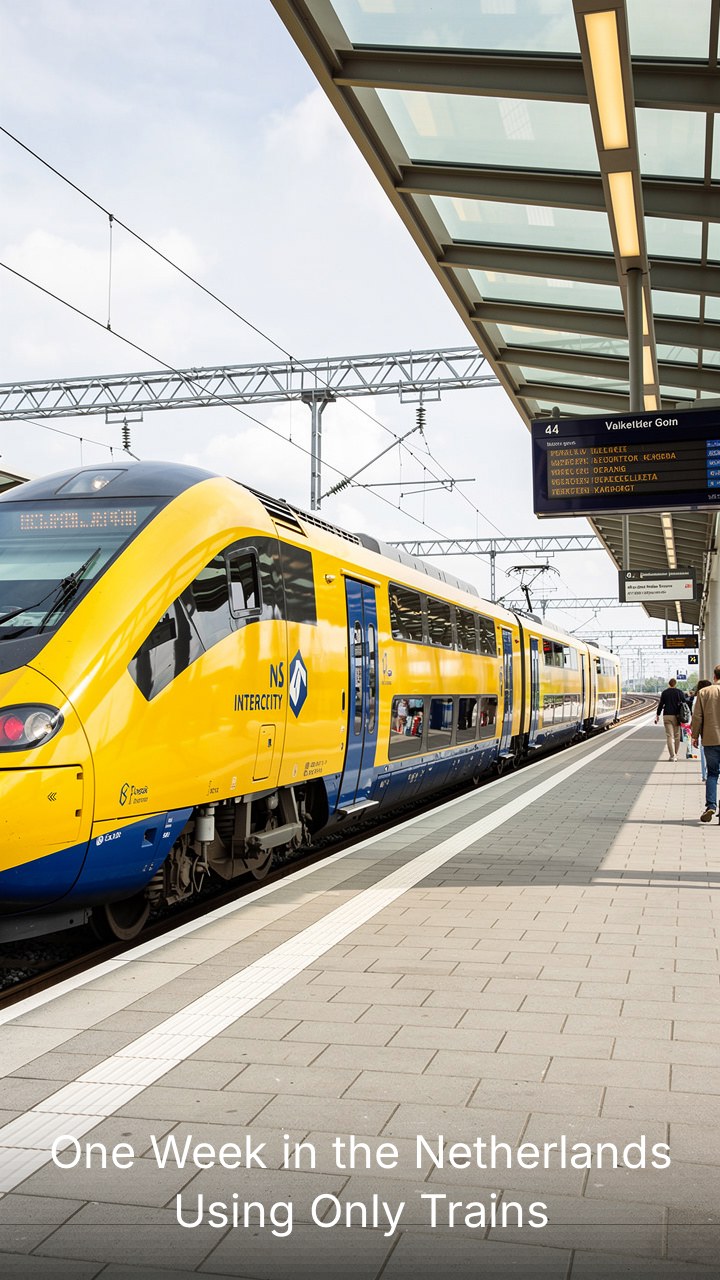
Your One Week Train Itinerary

Exploring the Netherlands in one week by train is highly efficient because the rail network connects all major cities within 30 to 90 minutes. Start by basing yourself in Amsterdam for two days to visit the Rijksmuseum, then spend your remaining days using the country’s dense, high-frequency rail connections to reach Utrecht, The Hague, Delft, Rotterdam, and Leiden.
Day 1-2: Amsterdam. Base yourself in the capital. Visit the Rijksmuseum and wander the Jordaan neighborhood. Use the trams for local movement.
Day 3: Utrecht. Take a 25-minute train from Amsterdam Central. Explore the canals and the Dom Tower.
Day 4-5: The Hague and Delft. These are close together. The Hague offers the Mauritshuis, while Delft is famous for its blue pottery.
Day 6: Rotterdam. A short 15-minute train from Delft. See the Cube Houses and the Markthal. The modern architecture is a sharp contrast to the rest.
Day 7: Leiden. Take a train back toward Amsterdam, stopping in Leiden. Its historic center is beautiful and quiet before your departure.
Practical Tips for Your Dutch Rail Adventure

Download the NS app immediately upon arrival to access real-time platform updates, live delay notifications, and the most accurate scheduling data available for the Dutch rail network. Do not rely on paper schedules because track changes often occur due to maintenance or sudden congestion, making digital agility essential for a stress-free journey.
For seamless payments, use the OV-pay system by tapping your contactless debit card, credit card, or mobile wallet on the yellow card readers at station gates. This eliminates the need for physical tickets or navigating complex ticket kiosks. Ensure you perform a check-in and check-out at every gate transition; failing to do so will trigger a penalty fare deduction from your account balance. If traveling with a group of three or more, investigate the ‘NS Group Ticket’ which offers significant cost savings, though these are strictly limited to off-peak travel times. Remember that rush hour periods, typically 06:30–09:00 and 16:00–18:30 on weekdays, exclude discounts, requiring you to pay full price regardless of your pass status.
Common Mistakes to Avoid
Many travelers incorrectly assume that a Eurail pass is the most economical way to see the Netherlands, when in fact, standard point-to-point tickets or OV-pay check-ins are almost always cheaper for domestic travel. Because Dutch cities are geographically close, the cost of a multi-day pass rarely breaks even compared to the convenience of pay-as-you-go ticketing.
Another frequent error is missing the ‘quiet zone’ markings on train carriages, designated as ‘Stilte’ (Silence) zones. If you converse loudly or play music here, you will face social backlash from local commuters; always look for the purple decals on the doors or windows. Furthermore, do not attempt to visit more than two cities in a single day. Dragging heavy luggage between stations and platforms significantly eats into your sightseeing time. Limit your hotel changes to every two or three nights to keep your transition logistics manageable and ensure you have enough time to actually enjoy the cultural highlights of each destination.
Choosing Between First and Second Class
Choosing between train classes in the Netherlands is a trade-off between standard efficiency and premium comfort. Second class is the national standard and is perfectly clean and reliable for any journey, particularly trips under one hour, which covers the vast majority of inter-city routes in the Dutch rail network.
First class offers wider seats, extra legroom, and often a quieter environment, which can be advantageous if you are traveling during crowded peak hours and want a better chance at securing a seat. In my experience, if you are traveling with large suitcases, the extra physical space in a first-class carriage makes the boarding and storage process significantly less chaotic. However, for a short 20-minute hop between Delft and Rotterdam, first class is an unnecessary luxury. Use the savings for a better lunch or an extra museum ticket. Stick to second class unless you have heavy luggage, a specific need for extra workspace, or are embarking on a longer cross-country trip where the additional comfort provides tangible value.
Checklist for a Stress-Free Train Trip
Before you board, check this list to ensure your journey goes as planned:
- Ensure your contactless bank card or phone wallet is fully charged and active for international payments.
- Confirm you have the NS app installed and set to English for immediate traffic alerts.
- Pack light; stairs at Dutch train stations are steep, and elevators are sometimes out of service.
- Carry a portable power bank, as onboard charging ports are sometimes non-functional or inconsistent.
- Keep your passport or a valid ID handy, as ticket inspectors may ask for it when validating digital tickets.
Frequently Asked Questions
Do I need to book my train tickets in advance?
No, you do not need to book in advance. Dutch domestic trains operate like a metro service where you simply tap your card and board the next train to your destination; prices are fixed, meaning there is no financial advantage to advance booking.
Can I take my bicycle on the train?
Yes, but you must purchase a ‘Fietskaart’ (bike ticket) and avoid travel during peak rush hours. It is usually more convenient to rent an ‘OV-fiets’ at your destination station, which is incredibly affordable and available at almost every major terminal.
Is the train system safe for solo travelers?
Yes, the Dutch train system is extremely safe and well-patrolled, making it an excellent option for solo travelers. You will find that most locals speak excellent English and are happy to provide directions if you have trouble navigating the platforms.
What should I do if I miss my train?
Simply wait for the next one; because frequencies are high (often every 10–15 minutes between major cities), missing one train is rarely a significant issue. Your ticket remains valid for the day of travel, so no rebooking is necessary.
Can I use my Eurail Pass in the Netherlands?
While you can use a Eurail Pass, it is rarely cost-effective for domestic travel within the Netherlands. The low cost of point-to-point tickets combined with the convenience of contactless OV-pay makes local systems much cheaper and easier for the average traveler.
Leave a Reply