
Sagrada Familia: The Ultimate Barcelona Guide
The Sagrada Familia is an unfinished minor basilica in Barcelona, Spain, designed by Antoni Gaudí and world-renowned for its organic, nature-inspired architecture. Construction began in 1882, and visitors today can explore its completed interior and three distinct facades, making it the most visited landmark in Catalonia.
The History of a Never-Ending Project
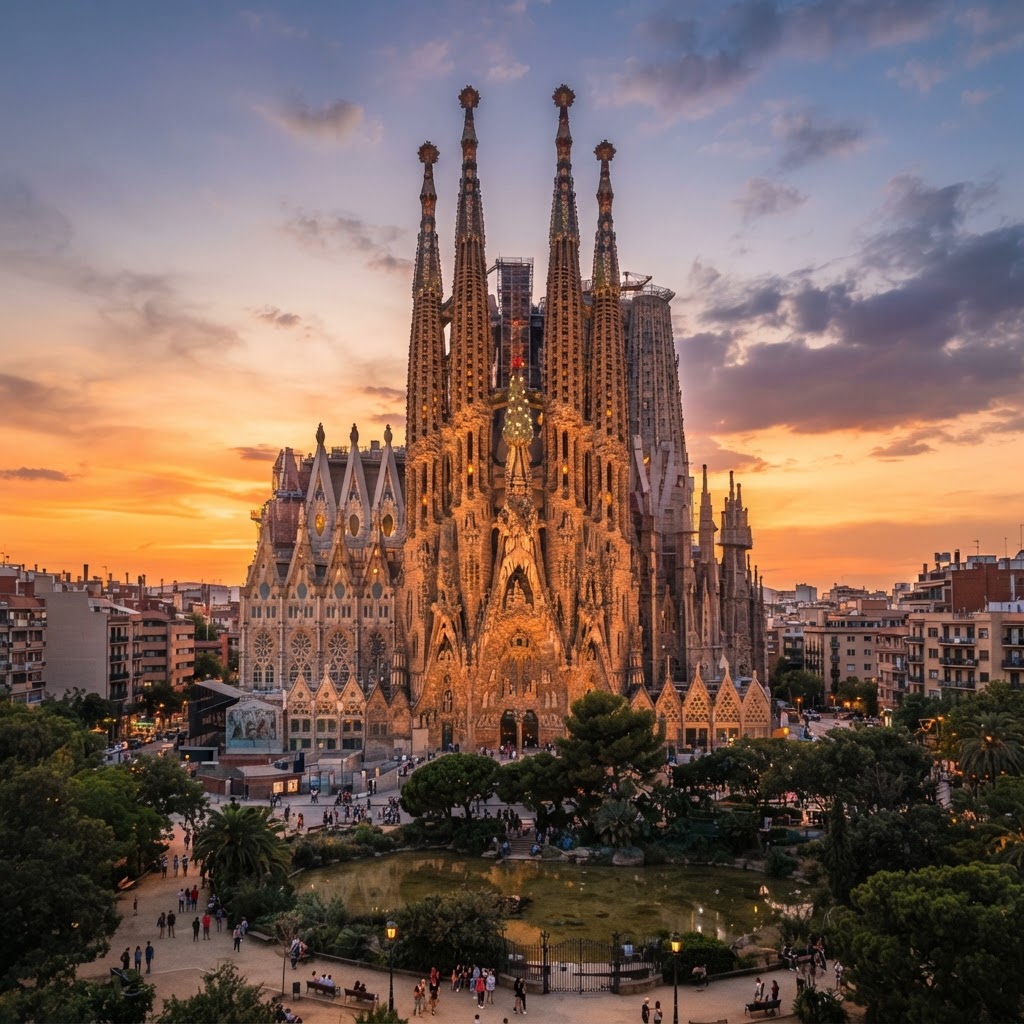
The construction of the Sagrada Familia began in 1882 under the direction of Francisco de Paula del Villar, but it was Antoni Gaudí’s appointment in 1883 that fundamentally transformed the project. Gaudí pivoted from traditional neo-Gothic plans toward a complex, structural expression of faith that mimics the natural world. Following Gaudí’s death in 1926, the project faced significant setbacks, including the destruction of original plans during the Spanish Civil War. Despite these interruptions and ongoing funding challenges relying primarily on private donations and ticket sales, modern architects utilize 3D modeling to continue the work. The site serves as a profound narrative of resilience, having spanned over 140 years of construction. The project is currently in its final phase, with the central towers expected to be largely completed by 2026, marking the 100th anniversary of Gaudí’s passing.
Understanding the Architectural Marvel
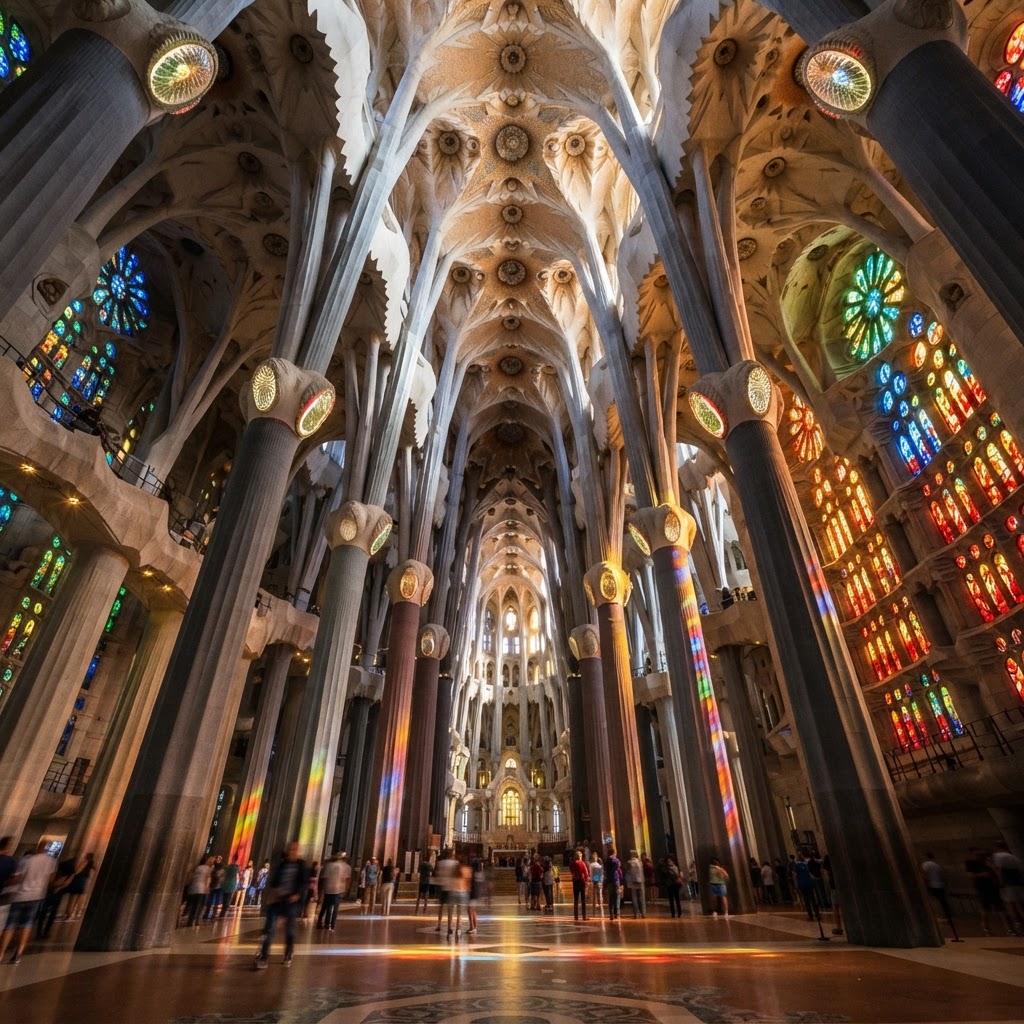
What makes the Sagrada Familia stand out among other global landmarks is its organic architecture, rooted in Gaudí’s belief that nature lacks straight lines. To achieve this, Gaudí pioneered the use of hyperboloids, parabolas, and helicoids, creating structures that distribute weight naturally without the need for traditional external buttresses. The building functions as a living laboratory of geometry where every stone column mimics a tree branching into a canopy, creating a space that feels simultaneously vast and intimate. This sophisticated use of structural engineering allows for soaring heights while maintaining a delicate, ethereal aesthetic that is unique in religious architecture.
The Three Majestic Facades
The exterior is defined by three distinct facades, each representing a different stage of Christ’s life:
- The Nativity Facade: Dedicated to the birth of Jesus, this is the most “Gaudí-esque” portion, characterized by intricate, flowing details.
- The Passion Facade: Stark and angular, this side represents the suffering of Christ during his final days.
- The Glory Facade: Still under construction, this will eventually be the largest and most grand of the three.
| Facade | Theme | Architectural Style | Status |
|---|---|---|---|
| Nativity | Birth of Jesus | Ornate/Naturalistic | Completed |
| Passion | Suffering/Death | Angular/Modernist | Completed |
| Glory | Resurrection/God | Monumental | In Progress |
Essential Tips for Securing Tickets
Securing Sagrada Familia tickets requires advance planning, as daily visitor numbers are strictly capped to ensure safety and preserve the site’s integrity. Because tickets often sell out weeks in advance, especially during the April-to-October peak season, booking through the official website is mandatory to guarantee entry. General admission prices currently start at approximately €26, with guided tours ranging from €30 to €40 depending on the inclusions. We highly recommend booking a slot for early morning or late afternoon to experience the interior lighting at its best. Note that the towers have specific age restrictions (usually 6+) and require separate tickets. Always carry your digital ticket QR code and a valid ID, as security checks are thorough and non-negotiable for all visitors.
Exploring the Breathtaking Interior
Stepping inside the basilica is an experience that words can hardly capture because the interior is designed to resemble a massive, stone forest. Massive columns branch out like tree trunks, supporting a canopy of colorful light that filters through the giant stained-glass windows. Gaudí utilized a specific color spectrum to manipulate the atmosphere: the Nativity side features cooler blue and green stained glass to represent the dawn and birth, while the Passion side utilizes warm oranges and reds to reflect the intensity of sunset and the crucifixion. This interplay of light is intentional, designed to make visitors feel as though they are walking through a living, breathing space that connects the earth to the divine. The acoustic quality is also highly specific, optimized for choral music, reflecting the architect’s desire for a fully immersive sensory experience.
The Future of Gaudí’s Vision
The project is currently in its final stages, with a target completion date aimed at the 100th anniversary of Gaudí’s death in 2026. This monumental effort involves the use of advanced 3D printing and digital modeling, allowing the modern team of architects to honor Gaudí’s original, complex geometry. Watching the cranes move around the spires is a reminder that the Sagrada Familia is a living work of art that continues to evolve even today.
FAQ
Q: Do I need to book Sagrada Familia tickets in advance?
Yes, booking tickets online in advance is essential as the basilica frequently sells out weeks before the visit date. Tickets are time-slotted to manage crowd density, and walk-up tickets are rarely available at the ticket office.
Q: What is the dress code for the Sagrada Familia?
Visitors must dress modestly as it is a place of worship, meaning shoulders and knees must be covered. Avoid wearing swimwear, tank tops, or extremely short shorts, or you may be denied entry by security staff regardless of your ticket purchase.
Q: How long does a visit to the Sagrada Familia take?
Most visitors spend between 90 minutes and two hours exploring the interior and the museum. If you opt for a guided tour or wish to climb one of the towers, consider adding an extra 45 minutes to your itinerary.
Q: Is the Sagrada Familia accessible for wheelchair users?
Yes, the Sagrada Familia is largely accessible, providing ramps and elevator access to most areas of the interior. However, access to the towers is generally restricted for those with limited mobility or certain medical conditions for safety reasons.
Q: When is the best time of day to visit for photography?
Visit during the morning (9:00 AM – 11:00 AM) or late afternoon (4:00 PM – 6:00 PM) for the best lighting conditions. These times allow the sun to shine through the stained-glass windows, projecting vibrant colors across the interior stone columns.
Insider Logistics and Practical Planning
Do not expect to walk up to the ticket office and buy a pass. You will waste hours in a line only to be turned away. Book your timed-entry tickets online at least three weeks before your trip. Print the QR code or keep it ready on your phone to bypass the main street-level queues.
The best time to arrive is 30 minutes before your scheduled entry. The security screening moves quickly, but the site managers are strict about timing. If you arrive late, your ticket may become invalid without a refund. Plan your arrival via the L2 or L5 metro lines; the Sagrada Familia station puts you right in front of the park.
How Long Should You Stay?
Budget at least two hours for the interior and the museum. If you plan to climb a tower, add 45 minutes to your schedule. The museum in the basement is often overlooked, but it holds the original plaster models and blueprints. Spend your extra time there to understand the sheer scale of the engineering effort.
The Great Tower Debate: Should You Climb?
You have two choices for tower visits: the Nativity Facade or the Passion Facade. Each offers a completely different perspective of Barcelona. The Nativity tower provides a closer view of Gaudí’s original, organic stone carvings. You will see the mountains of the city and the sea in the distance.
The Passion tower is higher and offers a better vantage point of the city center. It feels more industrial and modernist compared to the intricate Nativity carvings. Please note that you must descend via a narrow, spiraling stone staircase. If you suffer from vertigo or have knee mobility issues, stick to the floor level. The lift goes up, but the walk down is inevitable.
Common Mistakes Travelers Make
Many visitors focus only on the grand altar and ignore the floor-level details. Look down at the floor ventilation grates designed by Gaudí to circulate air naturally. Look up at the columns; they are designed to move slightly to mimic the sway of trees in the wind. These subtle details prove that the basilica is a biological machine, not just a stone structure.
Another common error is skipping the audio guide. The included app provides historical context that you cannot get from the walls alone. It highlights the hidden meanings behind the stained-glass color gradients. The blue-green glass on one side represents the cool morning, while the red-orange side represents the intensity of the sunset.
Essential Visitor Checklist
- Dress modestly; this is a place of worship. Shoulders and knees must be covered.
- Bring a portable power bank for your phone; the audio guide app drains battery quickly.
- Avoid visiting between 1:00 PM and 3:00 PM if you dislike crowds.
- Check the sunset times before booking; the light hitting the stained glass is most magical in the last hour before closing.
- Use the public toilets located near the exit; they are cleaner than most nearby cafes.
Frequently Asked Questions
Can I take professional photos inside?
Yes, handheld photography is permitted for personal use. Tripods, monopods, and professional lighting equipment are strictly prohibited. The interior is dark in many corners, so bring a camera that performs well in low light. Please remain respectful of worshippers who may be praying in the side chapels.
Are guided tours worth the extra cost?
Yes, if you value narrative over simple sightseeing. While the basic ticket gets you inside, a guided tour explains the symbolic geometry you would otherwise miss. If you are a history buff, a small-group guide is worth the extra 15 to 20 euros. Most guides offer tours in multiple languages, but verify your language preferences during checkout.
What should I do if my flight gets delayed and I miss my slot?
Contact the official visitor support email immediately. They rarely offer refunds for missed slots due to travel delays, but they sometimes allow a one-time change if there is capacity later that day. Do not count on this policy; treat your entry time as if it were a flight departure time.
Leave a Reply